There Will Never Be Enough Compute
The modality no one is pricing
Every single morning, you wake up, move your blanket aside, swing your legs out of bed, and place both feet on the floor without a second thought.
But pause for a moment and consider the computational cost behind that simple action.
The instant you open your eyes, on the order of a gigabit per second of visual information from three-dimensional reality begins streaming into your retinal system. The retina compresses and filters the raw feed, and the brain folds what’s left into its internal model of the world, effectively “prefilling” the context needed for action. Raw data in, a usable model of the room out: your morning begins with a massive act of computation.
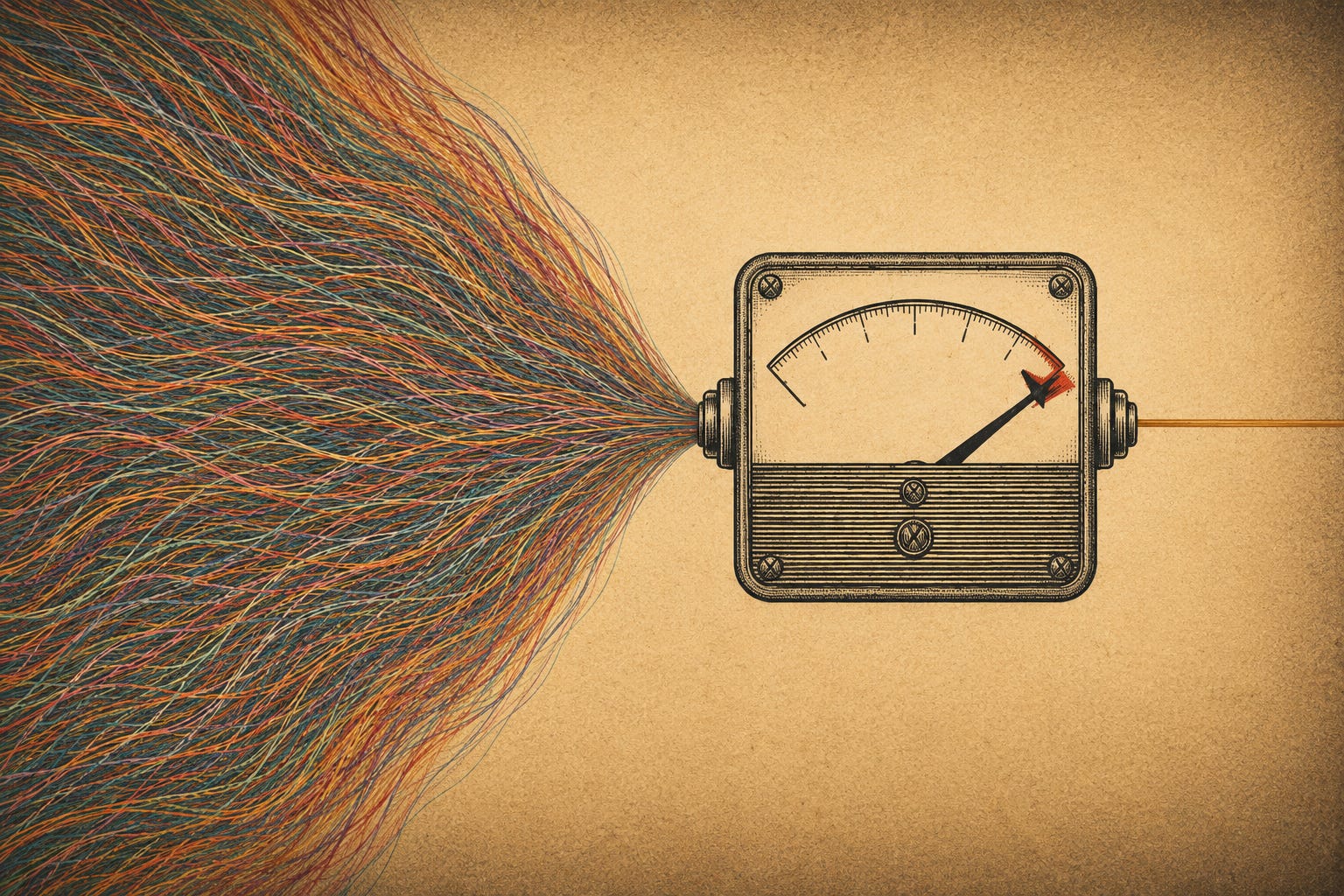
Try running that job on silicon and it sounds like a lot of compute. Let’s check the meter.
The meter needs three numbers: how rich your sensory stream is, how a modern model would tokenize it, and what a token costs today.
Start with the stream. Your photoreceptors take in on the order of 10⁹ bits per second. As a proxy, treat each eye as a camera recording 8K video at 60 frames per second. This is generous to the machines twice over. An 8K frame is about 33 megapixels, while each retina carries roughly 100 million photoreceptors.¹ And a camera records a flat image, while your eyes are two offset viewpoints that the brain fuses into a three-dimensional scene. Let’s throw the stereo geometry in for free.
Next, the tokenizer. Let’s use Google’s own accounting. Gemini’s video mode is built for summarizing footage, so by default it samples one frame per second and squashes each frame to 258 tokens.² We aren’t using that sampling rate here, only Gemini’s per-tile accounting. To match our 8K resolution, Gemini’s documentation specifies that images are cut into 768×768 tiles, each billed at 258 tokens.³ An 8K frame takes 10×6 = 60 tiles, so
60 × 258 ≈ 15,500 tokens per frame
At 60 frames per second, both eye streams
15,500 × 60 × 2 ≈ 1.9 × 10⁶ tokens/s
Your ten-second morning comes to
1.9 × 10⁶ tokens/s × 10 s ≈ 1.9 × 10⁷ tokens
1.9 × 10⁷ × ($2 / 10⁶) ≈ $37⁴
Run the meter over a full sixteen-hour waking day — 57,600 seconds — and one person’s bill balloons:
1.9 × 10⁶ × 57,600 ≈ 1.1 × 10¹¹ tokens ≈ $220,000 per day
For just one person! At I/O 2026, Google announced its entire fleet processes 3.2 quadrillion tokens a month⁵ — which works out to about 1.2 × 10⁹ tokens per second — across every product it runs, which sounds like a lot (and by today’s standards it is). Divide by your eyes’ 1.9 × 10⁶ tokens per second and the largest inference fleet on Earth is able to run the visual feed of only 650 people. For everyone to have their morning,
8 × 10⁹ people × 1.9 × 10⁷ tokens ≈ 1.5 × 10¹⁷ tokens
Ten seconds of humanity waking up would keep Google’s entire fleet busy for almost four years.
So we can relax — clearly there’s more compute than anyone could ever need. Except we’ve said that before, every time, and every time we were wrong.
The history of computing is littered with failed ceilings. The most famous is the line attributed to Bill Gates: “640K ought to be enough for anybody.”⁶ He almost certainly never said it, but the quote endures because it captures how the era genuinely thought. And it is in good company. Thomas Watson of IBM supposedly saw a world market for perhaps five computers.⁷ In 1998, Paul Krugman predicted the internet’s economic impact would be no greater than the fax machine’s.⁸
Time and again, humans blew past these ceilings with previously unthinkable uses of computing: a new paradigm, a new architecture, a new interface. What strikes me is how few people it took. The transistor came out of a single group at Bell Labs: Bardeen, Brattain, and Shockley, plus a supporting cast of perhaps a dozen. Nearly everything you’re using to read this, from the graphical interface to Ethernet, was invented in one building in Palo Alto by the few dozen researchers of Xerox PARC. Deep learning survived two AI winters inside a group small enough to fit in a seminar room, and AlexNet was two graduate students and their advisor training on a pair of GTX 580s in a bedroom in Toronto. And the Transformer, the architecture underneath every frontier model, arrived in a single 2017 paper written by eight researchers at Google.
And when those minds do conjure a new use, Rich Sutton's Bitter Lesson tells us which version of it wins: across seventy years of AI research, the approaches that prevail are the general methods that ride the curve of ever-growing computation, eventually crushing even the cleverest hand-engineered alternatives.⁹ Imagination sets the demand; the Bitter Lesson guarantees it's demand for compute.
Every one of these failed predictions has the same thing buried in it: at any given moment, new demand for compute has run through a few rooms' worth of minds, and each time we underestimated what they'd imagine. Even the Bitter Lesson had to be noticed by a mind imagining what all that computation was for. Every proclaimed ceiling on compute was really a ceiling on the intellectual output of a tiny group of people. That output was capped by the supply of minds like these, and until now, that supply has been the scarcest resource on Earth.
That “until now” is the subject of this two-part series. Taken to its natural conclusion, it leaves us staring at a compute shortage unlike any other. Part I walks the conservative path: it prices only the demand from use cases I can imagine today, and shows that even this swamps everything we're building. Part II walks the radical path, where the thing generating demand for compute is itself made of compute, and asks what ceiling is left.
The conservative path runs back through your bedroom: the meter we just checked prices only demand that exists today, and the world’s datacenters could not cover ten seconds of it.
Prefill Is the Hidden Workload
Your brain’s input and output are wildly mismatched. It takes in a datacenter’s worth of information every second, yet you narrate all of it at only about 150 words per minute—and you never notice the gap. How does the brain pull this off? Here we can borrow a concept from modern LLM serving: prefill/decode disaggregation. Your brain runs prefill, ingesting an enormous input context, at the same time it decodes. It never waits for the input to finish before producing output; both stages run in parallel.
AI workloads are already converging on this shape. Epoch’s request profiles put today’s average query at about 6,000 tokens in for 800 out, agentic workloads at 25,000 in per 1,000 out, and long-context agents at 128,000 in per 1,000 out.¹⁰ Inference tokens are increasingly context tokens. Follow that curve to its end and you arrive at the brain: 1.9 million tokens per second in, a couple of tokens out, a ratio near 600,000 to 1.
If these numbers feel too large to trust, good. An estimate this aggressive should raise strong objections. I’ll address three obvious ones.
1) “You don’t need an 8K, 60 fps, 3D stream to match human performance.” Tesla’s FSD looks like the knockdown counterexample: it handles rush hour on eight roughly one-megapixel cameras.¹¹,¹² But that frugality was bought with billions of miles of fleet video distilled into weights, and it’s spent on a single task in the most standardized environment humans have ever built, roads engineered to be legible at a glance. The moment machines leave the script, the sensor bill is instantly due: when Figure’s humanoids hit real kitchens, Figure 03 doubled its frame rate, quartered latency, widened each camera’s view by 60 percent, and grew cameras in its palms.¹³
2) “A Caltech study says the brain runs at just 10 bits per second.” True, and that is the decode side of the pipe we just walked through: Zheng and Meister¹⁴ clock the output, the trickle of conscious decision that behavior distills down to, while the same paper pegs the sensory inflow at the billion bits per second the meter is pricing.
3) “Nobody is actually running this workload. Real demand is for text.” True. This objection prices the future against the workloads that exist today, which is precisely the reasoning that produced every ceiling in the opening. 640K was enough for the software of 1981. Five computers were enough for the payroll batches of 1943. Today’s inference fleets look like enough for the text demand of 2026.
Text is a distillation
Every serious compute forecast starts in roughly the same way: take today’s text traffic, fit a curve, extend it. The unstated axiom is that text tokens will be a majority of what AI will consume. For example, Epoch AI’s compute-crunch forecast builds its demand curve from today’s text workloads: chat traffic and coding tokens. Measured that way, demand is growing roughly 10x a year, while the world’s inference capacity grows about 3.4x a year.¹⁰ Extend those two curves forward and demand outstrips supply in the near future; Epoch concludes a crunch is coming, with access to frontier models increasingly rationed by price. That 3.4x, though, counts hardware alone, leaving out inference efficiency, where the price of a fixed level of capability has been falling around 10x a year¹⁵, with Epoch’s own data putting the median closer to 50x.¹⁶ Stack efficiency on top of new chips and we land somewhere close to meeting projected inference demand. Given that frontier models are already helping to discover the efficiency gains that drive these price drops, I think efficiency will keep handing us breathing room in a world where only text tokens dominate.
But none of these curves counts a single pixel.
The omission is reasonable: text has dominated inference demand since the day AI had any, and text came first for a reason. For thirty years, the internet piled up the cheapest encoding of knowledge humans produce: language. A human brain took in a billion bits per second of lived reality and wrote out a few bytes of information-dense prose. The hardest step in learning about the world, turning raw experience into meaning, was already done, for free and at planetary scale, by the best teacher model available. And language came with an elegant training objective: predict the next word, score it with cross-entropy loss, and every sentence ever written becomes a labeled example. When compute went looking for something to learn from, text was the lowest rung on the ladder.
Text, in other words, is a distillation.
But distillation comes predefined with a hard ceiling: a student model cannot exceed its teacher. A model trained on our descriptions of the world tops out at our understanding of it. To go past us, an intelligence needs its own senses, its own billion-bit stream of raw reality with no human brain in the loop. If we want Dario Amodei’s country of geniuses in a datacenter¹⁷, someone has to build the datacenters, run the laboratories, mine the minerals both are made of. That work happens in the physical world, where the environment changes in milliseconds and perception decides the outcome. The geniuses will have to meet us out here.
I won’t go into much detail about what these world models, robotics models, and ASI-ish architectures will look like, partly because the people building them have already written it up better than I could. If you want the details, read Fei-Fei Li on spatial intelligence¹⁸, Meta’s V-JEPA 2¹⁹, DeepMind’s Genie 3²⁰, and Silver and Sutton’s Welcome to the Era of Experience.²¹
What I can do is price them. Start with the simple projection: one humanoid per human, and we run the meter again. Vision we have already priced: about 1.9 × 10⁶ tokens per second. Hearing is nearly free, with Gemini billing audio at 32 tokens per second.²² Touch is not: the best robot fingertips are cameras on the inside, and Meta and GelSight’s Digit 360 packs an 8-megapixel image of the skin’s deformation into each fingertip.²³ Ten fingers through Gemini’s tiling at 30 frames per second is another 1.1 × 10⁶ tokens per second, half a visual field from touch alone. Add joints, torque, and balance and a humanoid meters roughly 3 × 10⁶ tokens per second of pure prefill.
How far away are we from being able to serve this demand? Epoch’s report pegs all of today’s AI inference demand at ≈ 4 × 10⁹ tokens per second.¹⁰ Enough to run 1,300 humanoids. With 5.3 billion humans awake on average, give each of them a humanoid and we need to produce 1.6 × 10¹⁶ tokens per second, four million times everything we serve today. Google’s served tokens have grown roughly 7x a year⁵,²⁴, and that rate already bundles everything: new chips, better models, every serving-efficiency trick. Even if the frontier fleets sustain that pace, and every new token goes to humanoid senses while today’s text demand gets nothing, parity arrives around 2034. On chip buildout alone, Epoch’s 3.4x a year, it slips to 2038. And 5.3 billion is just parity with humans. None of this prices the humanoid-to-humanoid and agent-to-agent traffic that shows up the moment these systems start coordinating with each other.
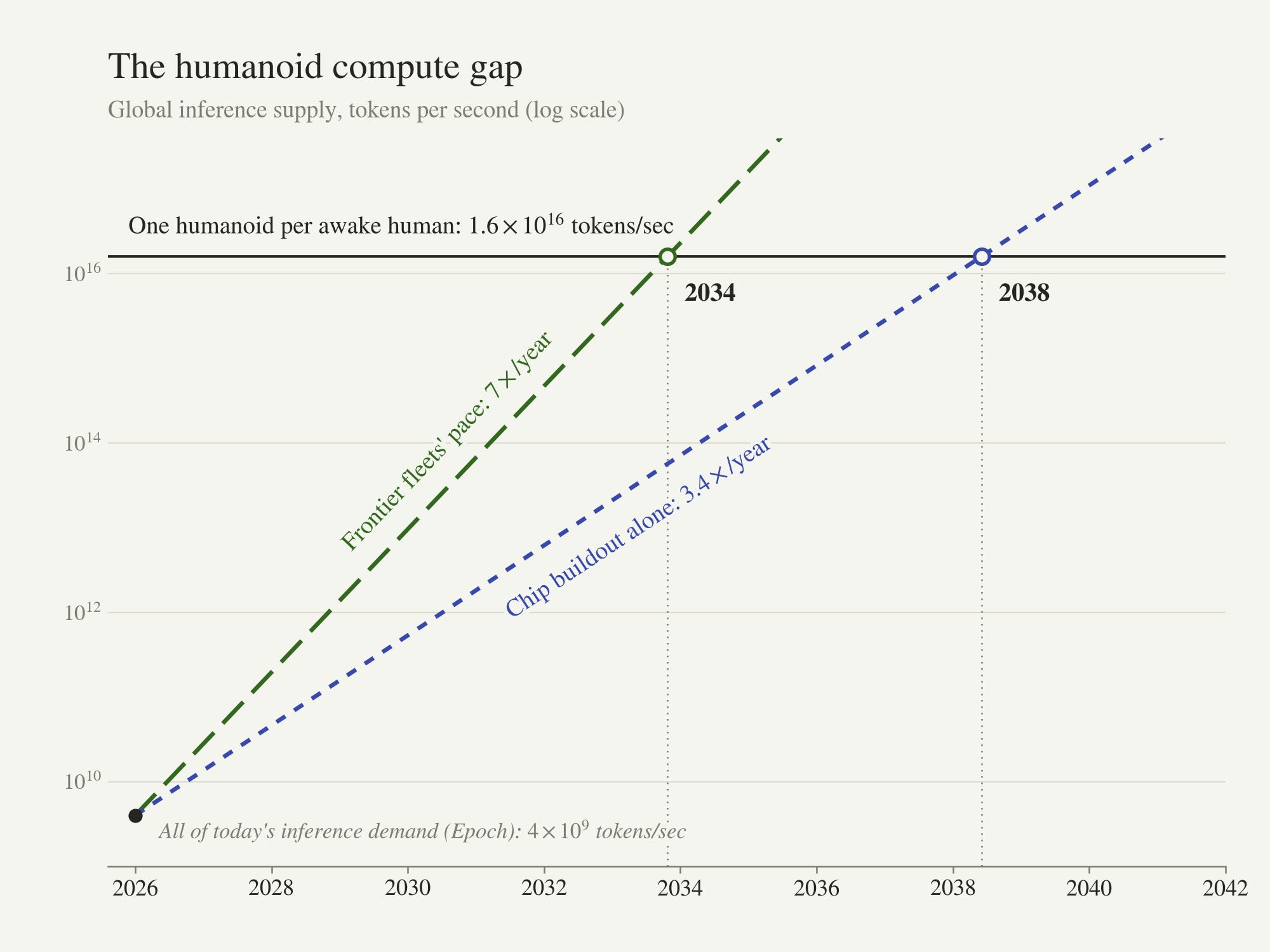
You can quarrel with the one-to-one ratio. Fine. Cut it by a factor of ten and parity moves from 2034 to about 2033: against 7x-a-year growth, an OOM of demand buys barely a year. History says we overshoot parity anyway: America keeps more registered vehicles than licensed drivers. And the meter prices sensory inference alone, with the training runs behind these robotics models and every other demand on the fleet, from chatbots to coding agents, left off the bill.
Still, the chart seems to contradict the title: hold demand at one humanoid per human, and the fleets catch up somewhere in the 2030s. Enough compute after all, a decade out. Except that demand line is just one workload that I, writing in 2026, imagine will dominate the years ahead. And the guess about the workload is the smaller of the chart’s two assumptions.
Every projection in this essay assumes the growth rates stay constant. For all of computing history that assumption was safe, because its bedrock never changed: demand has always waited on a few rooms’ worth of minds, Bell Labs, PARC, a bedroom in Toronto, to imagine what the machines were for. The use of compute has always been capped by humanity’s capacity to invent uses for it, and that capacity was fixed by the supply of human intelligence. This is why compute has moved in cycles of glut and shortage: overbuild capacity, wait for imagination to catch up, repeat. The fiber laid in the dot-com bubble sat dark for years until streaming and cloud arrived to light it up.
I truly believe that AI’s primary innovation is that it breaks this cycle at its most important bottleneck: the innovating part. For the first time, the thing that invents uses for compute is itself rising out of compute. Spend compute and you get intelligence that finds new ways to spend compute; the loop closes and starts feeding itself, and its byproduct is the world of The Gentle Singularity.²⁵ In a world where compute directly translates into intelligence, “excess compute” becomes an impossibility, since any surplus converts into more of the very thing that generates demand. When compute can generate demand for more compute, the only remaining constraint is the compute itself.
That loop is Part II.
Sources
1. https://www.ncbi.nlm.nih.gov/books/NBK545310 — human retina anatomy and photoreceptor counts
2. https://ai.google.dev/gemini-api/docs/video-understanding — Gemini video mode: 1 fps sampling, 258 tokens/frame default
3. https://ai.google.dev/gemini-api/docs/tokens — Gemini image tokenization: 768×768 tiles, 258 tokens per tile
4. https://ai.google.dev/gemini-api/docs/pricing — Gemini 3 Pro input pricing ($2/M tokens up to 200K context)
5. https://blog.google/innovation-and-ai/sundar-pichai-io-2026/ — Pichai at I/O 2026: 3.2 quadrillion tokens/month across all Google surfaces
6. https://news.ycombinator.com/item?id=18120477 — history of the 640K quote, why it’s almost certainly apocryphal
7. https://en.wikipedia.org/wiki/Thomas_J._Watson#Famous_attribution — the “five computers” line, also poorly sourced
8. https://www.snopes.com/fact-check/paul-krugman-internets-effect-economy/ — Krugman’s 1998 fax-machine prediction (real, he later called it a joke)
9. http://www.incompleteideas.net/IncIdeas/BitterLesson.html — Rich Sutton, “The Bitter Lesson” (2019)
10. https://epoch.ai/gradient-updates/is-a-compute-crunch-coming — Epoch AI: demand ~10x/yr vs inference supply ~3.4x/yr; demand proxies are text-only (Google tokens, Apple/Meta coder budgets), video/multimodal explicitly excluded
11. https://en.wikipedia.org/wiki/Tesla_Autopilot_hardware — HW3: 8×1.2MP cameras; HW4: 5MP cameras at native 36 fps
12. https://www.notateslaapp.com/news/1564/tesla-s-hw3-and-hw4-cameras-comparing-the-differences-in-quality-and-hardware — HW3 vs HW4 camera comparison (1280×960 vs 2896×1876 front)
13. https://www.figure.ai/news/introducing-figure-03 — Figure 03 vision system: 2× frame rate, ¼ latency, 60% wider FOV, palm cameras
14. https://www.cell.com/neuron/fulltext/S0896-6273(24)00808-0 — Zheng & Meister, “The Unbearable Slowness of Being” (Neuron, 2024): behavior distills to ~10 bits/s while sensory input runs ~10⁹ bits/s
15. https://a16z.com/llmflation-llm-inference-cost/ — a16z “LLMflation”: inference price at constant capability falling ~10x/yr
16. https://epoch.ai/data-insights/llm-inference-price-trends — Epoch AI: price at fixed benchmark performance falls 9x–900x/yr depending on task, median ~50x/yr
17. https://www.darioamodei.com/essay/machines-of-loving-grace — Amodei, “Machines of Loving Grace”: “a country of geniuses in a datacenter”
18. https://drfeifei.substack.com/p/from-words-to-worlds-spatial-intelligence — Fei-Fei Li, “From Words to Worlds”: spatial intelligence as AI’s next frontier
19. https://arxiv.org/abs/2506.09985 — Meta, V-JEPA 2: self-supervised video world model for understanding, prediction, and robot planning
20. https://deepmind.google/discover/blog/genie-3-a-new-frontier-for-world-models/ — DeepMind Genie 3: general-purpose world model, interactive 720p worlds at 24 fps
21. https://storage.googleapis.com/deepmind-media/Era-of-Experience%20/The%20Era%20of%20Experience%20Paper.pdf — Silver & Sutton, “Welcome to the Era of Experience”: agents learning from experience rather than human data
22. https://ai.google.dev/gemini-api/docs/audio — Gemini audio tokenization: 32 tokens per second of audio
23. https://ai.meta.com/research/publications/digitizing-touch-with-an-artificial-multimodal-fingertip/ — Meta/GelSight Digit 360: camera-based fingertip tactile sensor, ~8M taxels, 18+ sensing modalities
24. https://blog.google/technology/ai/io-2025-keynote/ — Pichai at I/O 2025: 480T tokens/month; 480T → 3.2Q over the year ≈ 7x/yr served-token growth
25. https://blog.samaltman.com/the-gentle-singularity — Altman, “The Gentle Singularity” (June 2025): “Intelligence too cheap to meter is well within grasp.”